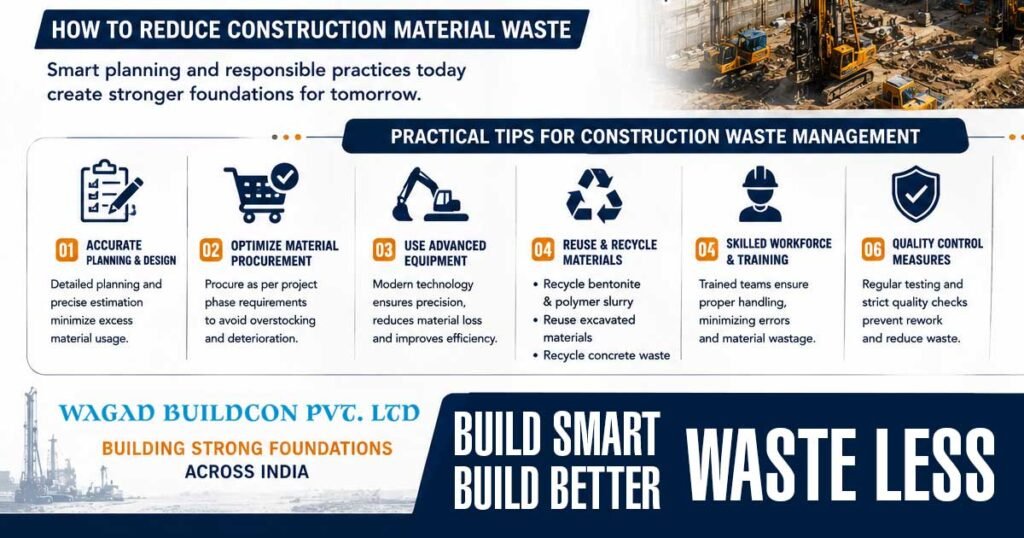
Smart planning and responsible practices today, create stronger foundations for tomorrow.
In today’s rapidly evolving construction industry, efficient resource utilization is not just a best practice – it is a necessity. Reducing construction material waste not only lowers project costs but also contributes to environmental sustainability and operational efficiency. At Wagad Buildcon Pvt. Ltd., we believe that strong foundations go beyond engineering – they include responsible construction practices, especially in specialized works like Diaphragm wall (Dwall) construction.
Understanding Construction Waste
Construction waste includes excess materials, damaged goods, improper handling losses, and inefficient execution processes. In projects involving deep foundation systems such as Diaphragm walls, managing materials like concrete, bentonite slurry, reinforcement steel, and polymers becomes critical.
Why Waste Management Matters in Dwall Construction
Dwall construction is a precision-driven process. Any material mismanagement can lead to:
- Increased project costs
- Delays in execution
- Environmental hazards
- Compromised structural integrity
Efficient waste control ensures that diaphragm wall systems are executed with accuracy, safety, and sustainability.
Practical Tips to Reduce Construction Waste
1. Accurate Planning & Design
Effective planning is the first step in minimizing waste. Detailed design calculations and proper site analysis help in estimating exact material requirements for Diaphragm wall panels, reducing overuse or surplus.
2. Optimize Material Procurement
Procure materials based on project phase requirements rather than bulk ordering. This prevents deterioration and unnecessary storage losses, especially for cement, chemicals, and reinforcement steel.
3. Use Advanced Equipment & Technology
Modern machinery and techniques improve precision in execution. In Dwall construction, advanced rigs and slurry management systems reduce material loss and enhance efficiency.
4. Reuse & Recycling of Materials
- Recycle bentonite and polymer slurry through desanding plants
- Reuse excavated materials where feasible
- Implement concrete waste recycling practices
This significantly cuts down disposal costs and environmental impact.
5. Skilled Workforce & Training
A well-trained workforce ensures proper handling of materials. At Wagad Buildcon, our experienced teams minimize errors during trenching, reinforcement placement, and concreting in diaphragm wall works.
6. Quality Control Measures
Strict quality checks prevent rework, which is a major source of waste. Regular testing (like slurry tests, cube tests, etc.) ensures materials are used effectively the first time.
7. Proper Storage & Handling
Improper storage leads to material damage. Ensure:
- Covered storage for cement and chemicals
- Organized steel stacking
- Safe handling of slurry and additives
8. Lean Construction Practices
Adopting lean construction techniques helps eliminate inefficiencies, optimize workflows, and reduce unnecessary consumption of materials.
Role of Innovation in Waste Reduction
Innovation plays a key role in minimizing waste in Diaphragm wall construction. From automated batching systems to real-time monitoring, technology helps maintain consistency and reduce material loss.
Our Commitment
At Wagad Buildcon Pvt. Ltd., sustainability and efficiency are integral to our operations. With our expertise in Dwall construction across India, we implement best practices to:
- Optimize material usage
- Reduce environmental impact
- Deliver cost-effective solutions to clients
Our approach ensures that every Diaphragm wall we build is not only structurally sound but also environmentally responsible.
Conclusion
Reducing construction material waste is not just about saving costs—it’s about building smarter and more sustainably. By adopting practical waste management strategies, especially in specialized areas like Diaphragm wall construction, companies can significantly improve efficiency and project outcomes.
Build Strong. Build Smart. Build Sustainable – with Wagad Buildcon.